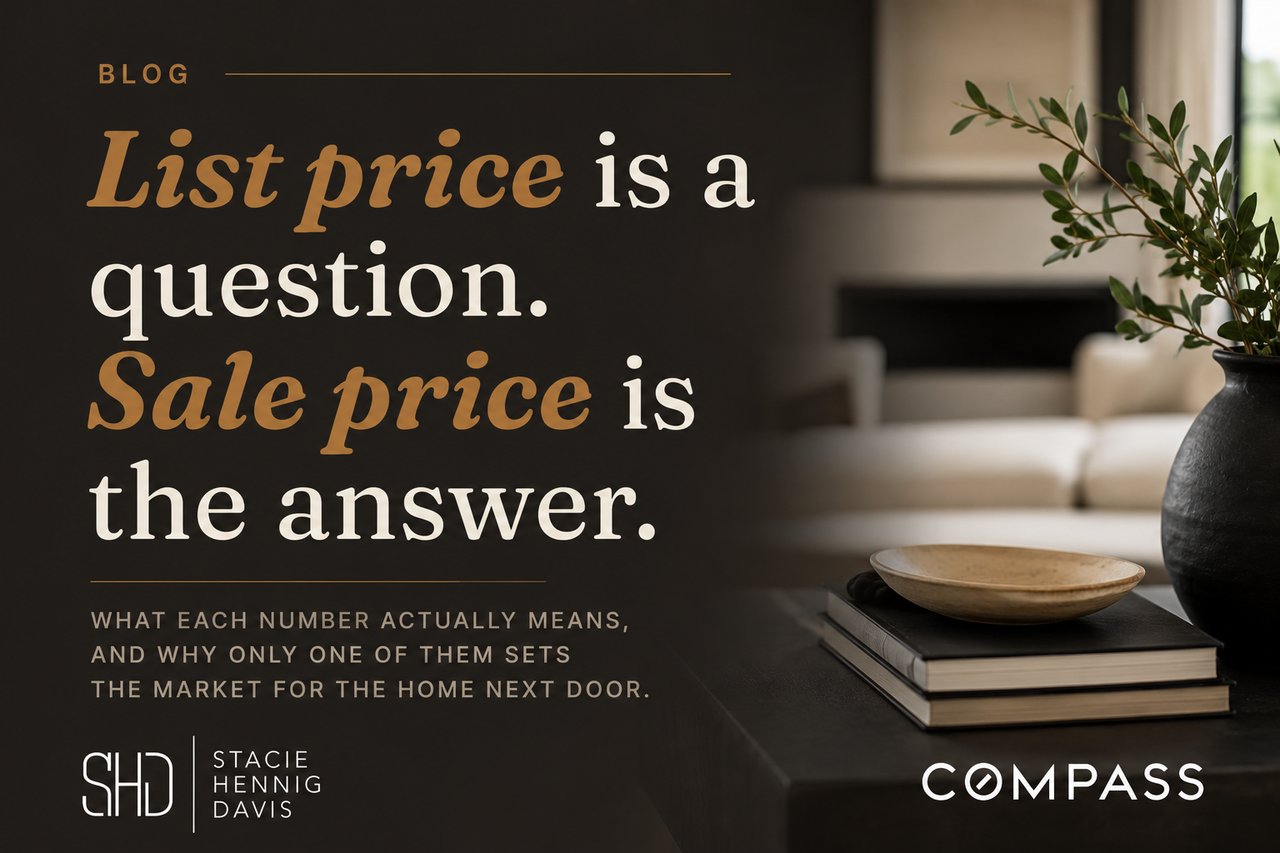
One of the biggest misconceptions in real estate is that a home's asking price tells you what it's worth.
It doesn't.
The list price is where the conversation begins. The sale price is where the market delivers its answer.
Understanding the difference can help buyers make stronger offers, sellers create smarter pricing strategies, and homeowners better interpret what's happening in their neighborhood.
The List Price
The list price is simply the number a seller chooses when their home enters the market.
That number isn't pulled out of thin air. It's typically based on recent comparable sales, the home's condition, current market conditions, and the seller's goals. But at the end of the day, it's still a strategy.
A seller can list a home at almost any price they choose.
Some homes are intentionally priced below market value to generate multiple offers. Others are priced aggressively with room to negotiate. Still others are simply overpriced.
That's why the asking price, by itself, tells you very little about a home's actual market value.
The Sale Price
The sale price is the number that truly matters.
It's the price a buyer and seller agree upon after negotiations are complete and the transaction closes. It becomes part of the MLS and the public record, making it the data that agents, appraisers, and lenders use when determining the value of other homes.
Unlike the list price, the sale price reflects what someone was actually willing to pay in the current market.
It's no longer an opinion.
It's evidence.
Why They're Different
The gap between list price and sale price is where negotiation happens.
Several factors influence where a home ultimately sells, including:
Competition. Multiple buyers competing for the same home can drive the sale price above asking.
Condition. Inspection findings, needed repairs, or seller concessions can lower the final price.
Time on Market. The longer a home sits without selling, the more negotiating power buyers often gain.
Pricing Strategy. An accurately priced home often generates stronger interest, while an overpriced home may require price reductions before attracting serious buyers.
Every transaction has its own story, and the final sale price reflects all of those moving pieces.
Why It Matters
Only one of these numbers becomes a comparable sale.
When an appraiser values your home, they don't look at what nearby homes were listed for. They look at what those homes actually sold for.
Every closed sale helps establish the value of the next home that comes to market.
So when you're researching your neighborhood online, remember:
The asking prices are the conversation.
The sold prices are the conclusion.
One More Number
There's one more misconception that's worth clearing up.
The sale price is not the amount a seller takes home.
Closing costs, negotiated credits, mortgage payoff, commissions, taxes, and other settlement expenses all come out of the sale proceeds.
Two homes can sell for exactly the same price while producing very different financial results for their sellers.
That's why evaluating an offer isn't just about the number at the top of the page. It's about understanding the entire package.
Let's Talk It Through
If you're thinking about buying or selling this year, I'd love to help you understand what the numbers are really telling us. Together, we can review what's happening in your neighborhood, interpret the sold data, and develop a pricing strategy that's grounded in today's market, not just the asking prices.
No pressure, just a clear-eyed conversation about your options.
I proudly serve buyers and sellers throughout Northern Virginia, including Reston, Herndon, Oakton, Fairfax, Vienna, McLean, Great Falls, Arlington, Alexandria, eastern Loudoun County, and northwestern Prince William County.
Stacie Hennig Davis, Realtor®
Compass
M: 703.400.8402
[email protected]